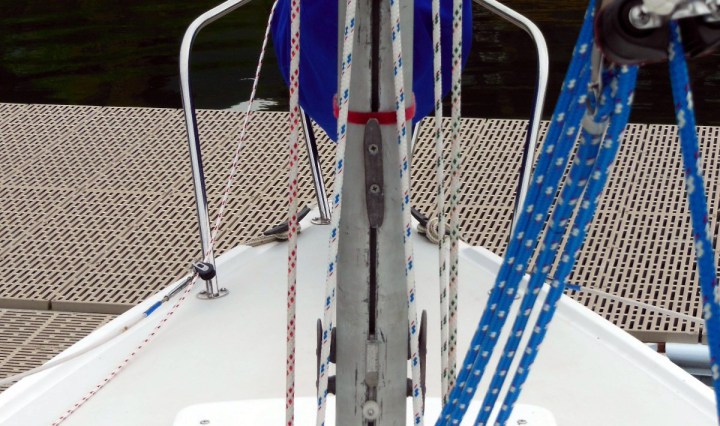
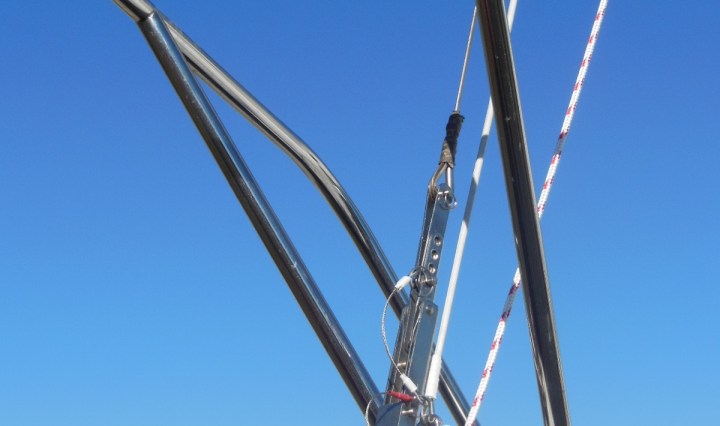
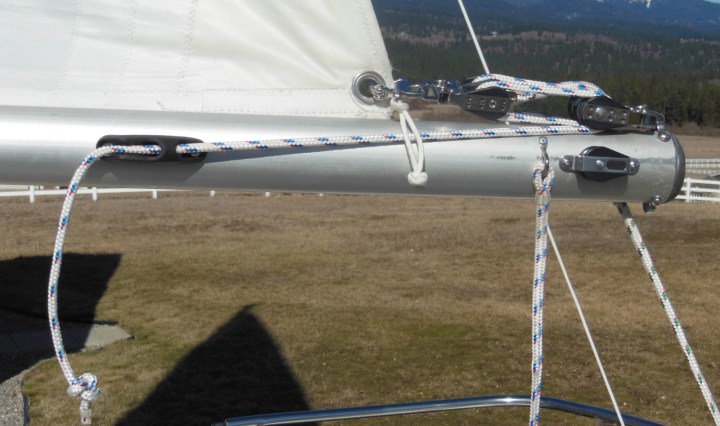
Flatten Your Mainsail Foot With an Outhaul

You’re familiar with basic mainsail running rigging, right? The halyard hoists it up the mast and the main sheet adjusts the angle of the sail to the hull. Both lines are important but they don’t adjust the aerodynamic shape of the mainsail, which can make a big difference if you want to get the best performance out of your mainsail.

Continue reading “Flatten Your Mainsail Foot With an Outhaul”

Headsail Furlers For the Trailer Sailor

I used to be a little envious of skippers with headsail furlers. They can just pull a line to roll up their headsail at the end of the day. Their headsail stays crisper longer because it doesn’t get folded up and stowed away. To set sail, they can just pull the sheets aft to unfurl the sail in seconds. No more snapping and unsnapping, hoisting and dousing, flaking and rolling. Just pull and go or pull and stop.

Continue reading “Headsail Furlers For the Trailer Sailor”

Choose Your Running Rigging Colors Logically

When we purchased Summer Dance, she had an odd assortment of line colors, mostly the original equipment, run of the mill white with a blue tracer. But the main sheet was white with a red tracer, the jib sheet too, and the genoa sheet was white with a black tracer. None of the colors gave you a clue as to what a line was used for. The halyards in particular were difficult to tell apart unless they were in their proper places.

After you know your sailboat so well that you can sail her in the dark, colors don’t matter, of course. But when you have crew onboard that don’t know your sailboat so well, they need all the help they can get to identify your lines.

Continue reading “Choose Your Running Rigging Colors Logically”

Control Your Mainsail Shape Better With a Boom Vang

A boom vang is a useful control for your mainsail, especially if the mainsail is older and acting its age. That is, if it’s getting baggy and is difficult to flatten, particularly when you’re pointed off the wind. For better performance and safety, you need to be able to pull excess twist out of the mainsail and flatten the leech. The best way to do that is with a boom vang. It has the added benefit of preventing the end of the boom from raising so high during gybes that it can snag the backstay, a potentially dangerous situation if the wind is strong enough.

Continue reading “Control Your Mainsail Shape Better With a Boom Vang”

Upgrade Your Rig With a DIY Adjustable Backstay

At some point when you get serious about sail trim, whether for racing or just high performance cruising, you’re going to want an adjustable backstay. Most C-22s and similar daysailers were rigged at the factory with fixed length backstays that are only slightly adjustable with a turnbuckle. They’re not intended for adjusting to different wind conditions. You set it and forget it.

Consequently, you only have one setting for mast bend and headstay tension. That’s fine for casual cruising. Set it for the conditions that you usually sail in and it will usually be close. But an adjustable backstay gives you a range of trim positions to optimize the mainsail and headsail shape for any conditions, which are what you can encounter when racing or when you’re no longer just a fair weather skipper. 

Continue reading “Upgrade Your Rig With a DIY Adjustable Backstay”

How to Reinforce Your Stem Fitting

While removing and rebedding all the deck hardware on Summer Dance with butyl tape, I decided that I would reinforce the stem fitting while I was at it. A popular online Catalina parts retailer’s website says:

Boats built before ’82 had an inherent weakness: The forestay load was forward of the stem fitting’s forward mounting bolts, supported only by the deck, in an area with many holes in a small space, all forward of the marine plywood reinforcement. It is common to see these Catalina 22’s with stem fittings that are being pulled up from the deck.

Deck failure begins by looking like the picture below. Notice the line of cracks just in front of the forward stem fitting bolts.

Continue reading “How to Reinforce Your Stem Fitting”

Handy and Cheap Line Hangers

When I first started sailing, I stored all my unused lines, sheets, and cords in a large plastic bag in the starboard lazarette. I knew there was a better way to organize them, but I hadn’t seen it yet. First, I came across some teak line caddys. And while I liked their design and the fact that the teak would look at home in Summer Dance, they wouldn’t afford a lot of storage for the amount of space that they would occupy. In a C-22, you have to maximize every cubic inch.

Continue reading “Handy and Cheap Line Hangers”

How to Rig a Cruising Spinnaker in 4 Stingy Stages

If you don’t have a spinnaker for your sailboat yet, aren’t you a little envious of those big, colorful, billowing sails you sometimes see at your favorite cruising spots? Nothing says, “Yeah, we’ve got this!” quite like a racing or cruising spinnaker. It’s as though the sailboat is puffing its chest out with confidence and strength. No wonder it’s called the fun sail.

In this post, I describe the strategy I used to get started with an asymmetrical spinnaker. You can use the same strategy with a symmetrical spinnaker but the cost is higher due to the required whisker pole and its control lines.

Continue reading “How to Rig a Cruising Spinnaker in 4 Stingy Stages”