

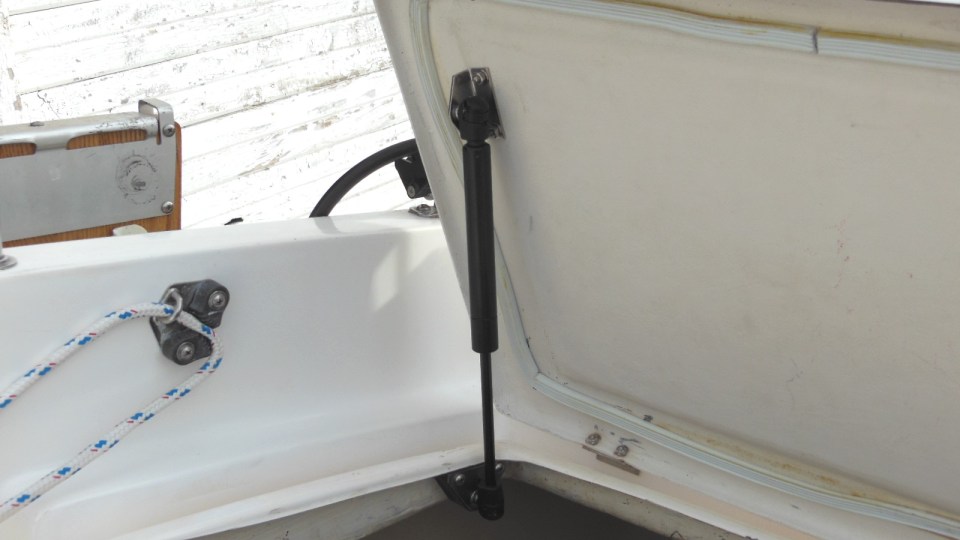


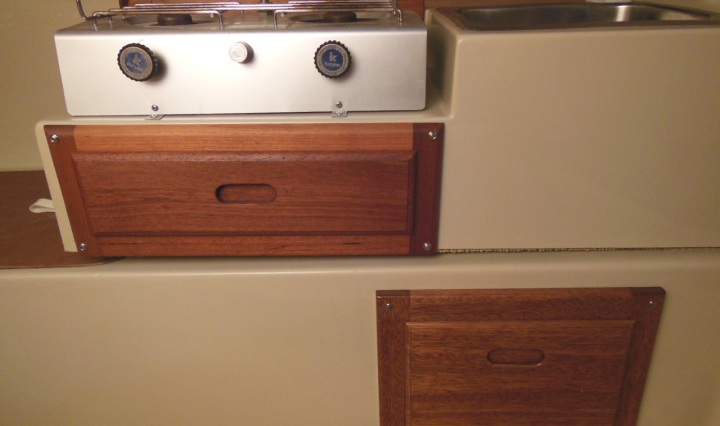
Make a Door for More Storage Under the Galley
Is there ever enough storage space on our little boats? Maybe if you only day sail. But if you anchor out much, particularly over long holiday weekends or longer, no. Your first mate will probably let you know about it like mine. Often. Yet there is a lot of useful, if difficult to get to space, for example, under the galley. The challenge is to make it easier to use. No doubt, Catalina Yachts left out access doors to this and other spaces in the cabin to keep costs down.
Continue reading “Make a Door for More Storage Under the Galley”
Turn Scrap Lumber into an Outboard Motor Stand
My most essential tool for working on my outboard motor is its stand. Without it, maintaining my 80+ pound, 8 HP Yamaha 4-stroke would be like a wrestling match.
Continue reading “Turn Scrap Lumber into an Outboard Motor Stand”
Remove and Prevent Mildew for Pennies
This guest post is from Drew Frye and first appeared on his blog, Sail Delmarva. Drew also tests products for Practical Sailor magazine and writes for other magazines like Good Old Boat. He graciously agreed to let me reproduce his article here.
The great myth of boat ownership—other than believing that everything takes 3 times as long and costs 4 times as much as you expect—is that mildew is ubiquitous. No matter how leak-tight, no matter how well maintained, it is always there. Well, I disagree wholeheartedly, and I challenge anyone to find any in my cabin. How have I dodged this scourge?

Control Your Mainsail Shape Better With a Boom Vang
A boom vang is a useful control for your mainsail, especially if the mainsail is older and acting its age. That is, if it’s getting baggy and is difficult to flatten, particularly when you’re pointed off the wind. For better performance and safety, you need to be able to pull excess twist out of the mainsail and flatten the leech. The best way to do that is with a boom vang. It has the added benefit of preventing the end of the boom from raising so high during gybes that it can snag the backstay, a potentially dangerous situation if the wind is strong enough.
Continue reading “Control Your Mainsail Shape Better With a Boom Vang”
How To Install a Tiller Autopilot
I hadn’t seriously considered an autopilot for Summer Dance until I discovered the affordable Raymarine ST1000+ Tiller Pilot and that they could be had for half the cost of new on eBay. When I thought of how convenient it would be for cruising with my wife who has no desire to take the helm, I concluded that it might free me up to attend to the many other responsibilities of single-handed sailing.
Continue reading “How To Install a Tiller Autopilot”
Upgrade Your Rig With a DIY Adjustable Backstay
At some point when you get serious about sail trim, whether for racing or just high performance cruising, you’re going to want an adjustable backstay. Most C-22s and similar daysailers were rigged at the factory with fixed length backstays that are only slightly adjustable with a turnbuckle. They’re not intended for adjusting to different wind conditions. You set it and forget it.
Consequently, you only have one setting for mast bend and headstay tension. That’s fine for casual cruising. Set it for the conditions that you usually sail in and it will usually be close. But an adjustable backstay gives you a range of trim positions to optimize the mainsail and headsail shape for any conditions, which are what you can encounter when racing or when you’re no longer just a fair weather skipper.
Continue reading “Upgrade Your Rig With a DIY Adjustable Backstay”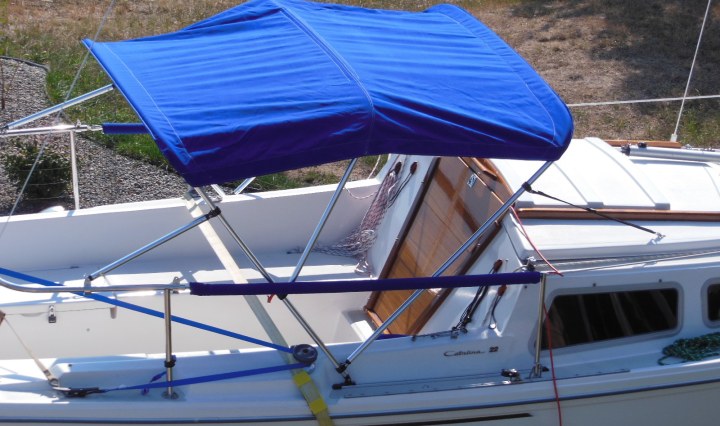
Upgrade To a Bimini Top On a Budget
The first mate and I live at around 48 degrees north latitude, which means that we don’t get a lot of hot weather. We have four distinct seasons and enjoy them all. It will get to around 100 degrees for a couple of weeks in August, but that’s as hot as it gets. The rest of the summer is in the 80’s and 90’s.

How to Sew Cabin Cushion Covers
One of the many things that Catalina Yachts did right in building their sailboats was the upholstery: tough fabrics and bomber construction. You have to forgive the colors and patterns. Fashion is, well, fashion. It comes and goes and comes again.
Continue reading “How to Sew Cabin Cushion Covers”
Fix Those Leaky Windows!
The most common cause of water leaks into the cabin of first generation C-22 sailboats besides the chain plates, are the aluminum frame windows, also called portlights. The silicone that seals the glass to the frame eventually loses its adhesion and elasticity and separates from the glass. Water accumulates in the vinyl glazing channel, which isn’t watertight. The water works its way into the cabin, adding to condensation and causing stains, mildew, and odors.
Continue reading “Fix Those Leaky Windows!” The $tingy Sailor